
Nuclear Desalination: A Solution to the Permian’s 25-Million-Barrel/Day Water Problem?
Who said uranium and water don't mix?

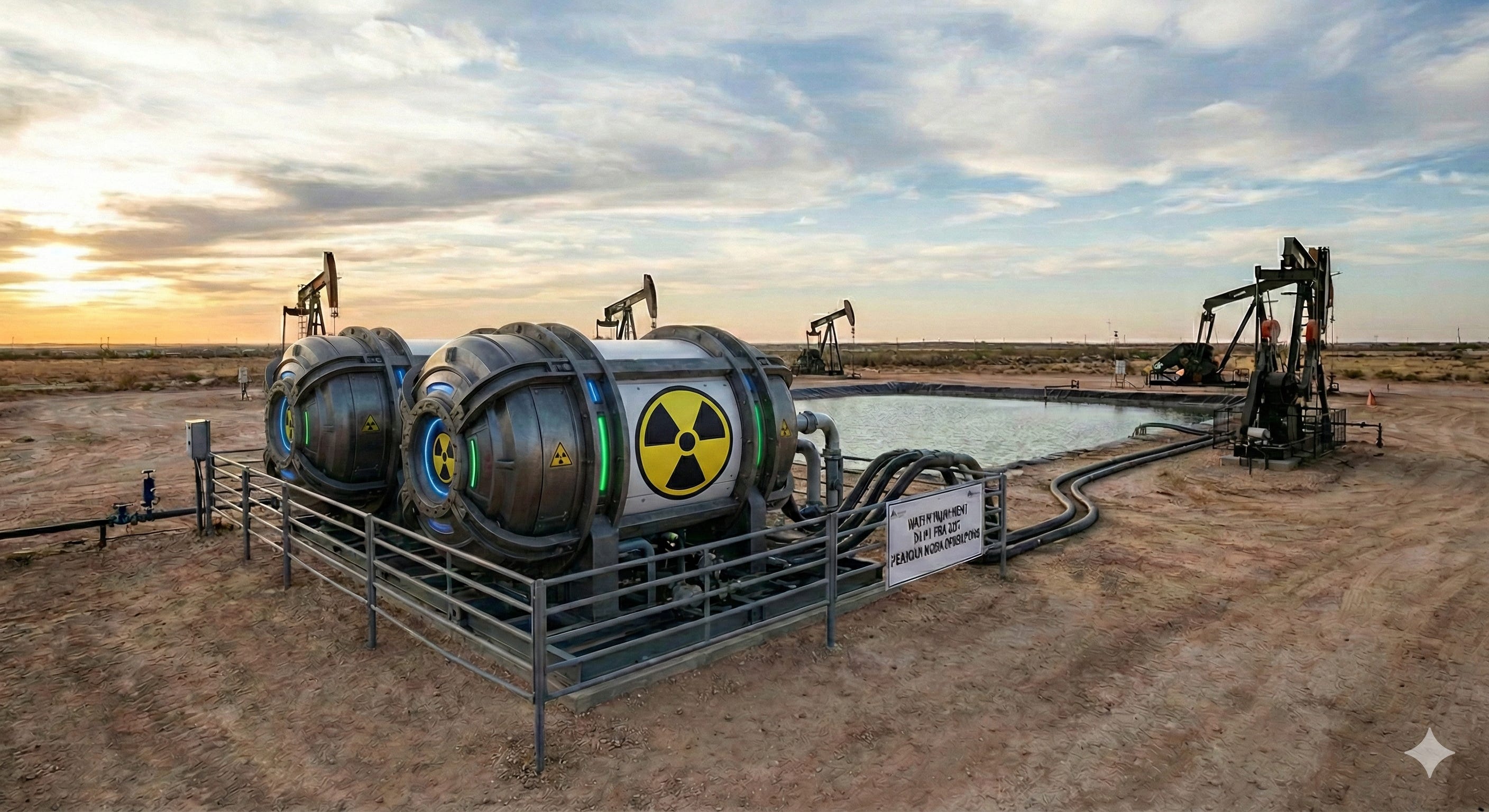
The Permian Basin is currently drowning in its own success. For every barrel of oil pulled from the ground, approximately five barrels of produced water—often laden with salts and laced with hydrocarbons—come with it. We are now dealing with roughly 25 million barrels per day of this fluid. About 40-ish percent can be reinjected into conventional oilfields and used to drive further oil recovery. But the other 15 million barrels per day—enough water to fill a string of railroad tank cars stretching from Midland to Amarillo—needs a place to go.
So far, this “place” has been an injection disposal well. But increasing seismicity, blowouts from old, corroded wellbores, and instances of lost production when injected water intrudes into producing formations are forcing a rethink. The stakes are high, as the Permian accounts for about 6% of global oil output and a sizeable proportion of US gas output. Ensuring continued security and viability of oil and gas production in this strategically vital basin will require a range of solutions to repurpose water and “shrink” injection volumes. Nuclear desalination could be one of these.
As former PBPA Chairman Kirk Edwards noted in 2025, the industry needs a “Manhattan Project” for produced water. Paradoxically, the core tools of the original Manhattan Project—nuclear reactors—may be the exact solution required.
Why Nuclear? Heat is the Hero
While most people think of nuclear reactors as electricity sources, their biggest value in the oilfield water space is process heat.
Oilfield water is a nightmare for standard treatment. It is highly saline and contaminated with hydrocarbons, which quickly foul the membranes used in traditional reverse osmosis. Nuclear-powered thermal distillation (specifically Multi-Stage Flash, or MSF) is far more robust. It uses reactor heat to boil the water molecules away, leaving a concentrated brine with the salt and toxins behind.
The goal isn’t just “cleaning” the water; it’s “shrinking” the problem. A standard MSF system yields about 2 barrels of pure water for every 10 barrels of raw feed, creating a high-quality water stream for industrial use or data centers while meaningfully reducing the volume of brine that must be injected.
To illustrate, running 10 million barrels per day of produced water through nuclear desalination units could realistically produce 2 million bpd of purified water and leave 8 million barrels per day of more concentrated brine that could be a chemical extraction feedstock but would ultimately need to be injected into disposal wells. Two million barrels per day of freshwater is about 94,000 acre feet per year—approximately twice the volume supplied by San Antonio’s Vista Ridge Pipeline project.
The Kazakh Precedent
Large-scale nuclear desalination isn’t science fiction. From 1973 to 1999, the Soviet Union and Kazakhstan operated the BN-350 sodium-cooled fast reactor near the Caspian Sea. It successfully produced 125 MW of electricity while simultaneously yielding over 500,000 barrels of desalinated water per day. It’s worth noting that at roughly 12,800 mg/l TDS Caspian Sea water is only about 1/3 the salinity of seawater and much less saline than most Permian produced waters. With that in mind, the Aktau project’s 25 years of successful nuclear desalination suggest the concept can work even in remote and demanding locations.
So what do the parameters look like in practice?
Techno-Economic Parameters
The numbers suggest that “The Nuclear Oilfield” isn’t just a technical fix—it’s a massive business opportunity. A modeled 2-reactor pod (one optimized for heat, one for electricity) shows a path to profitability:
· Payback Period: Between 3 and 5 years depending on capital costs.
· Revenue Streams: Operators could charge $0.45/bbl to take produced water (competitive with disposal wells) while selling clean distillate for $0.25/bbl and wholesale power for $75/MWh.
· Scale: A single facility could process nearly 600,000 barrels of water per day.
Simple Model for Permian basin Nuclear Desalination Facility
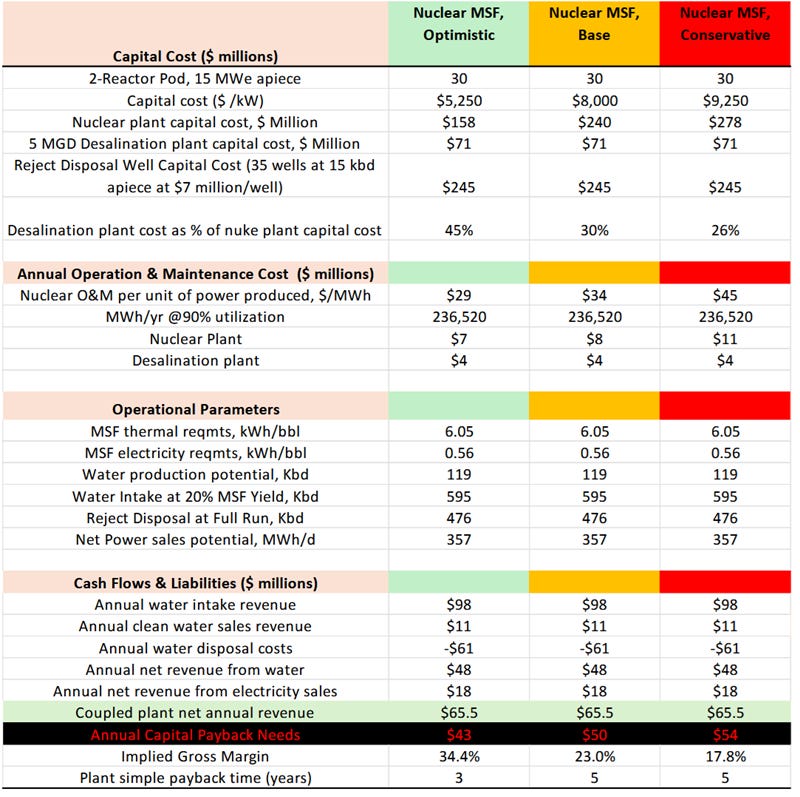
Source: Author’s analysis based on these sources: Tewari, Pradip K., and Ibrahim Khamis, “Desalination & Water Management: Opportunities & Issues,” presentation at the 16th INPRO Dialogue Forum on Opportunities and Issues in Non-Electric Applications of Nuclear Energy, Vienna, Austria, December 12, 2018; Larsen, Levi M., Abdalla Abou-Jaoude, Nahuel Guaita, and Nicolas Stauff, “Nuclear Energy Cost Estimates for Net Zero World Initiative,” Idaho National Laboratory, INL/RPT-23-74378, 2024; based on smallest reactor size parameter offered in Oklo Inc. Q4 2024 Quarterly Company Update, Santa Clara, CA: Oklo Inc., March 24, 2025; Phillips, S.L., A. Igbene, J.A. Fair, H. Ozbek, and M. Tavana, “A Technical Databook for Geothermal Energy Utilization,” LBL-12810, UC-66a, Berkeley, CA: Lawrence Berkeley Laboratory, University of California, June 1981 (p. 32 of 60), Molal concentration calculated using Calculator.net “Molarity Calculator”; Morin, O.J., “Cost Aspects – MSF,” in “Thermal Desalination Processes” Vol. II, 1–9, Black and Veatch, Florida, USA, accessed April 29, 2025.
A Necessary Reality Check
Moving toward a nuclear oilfield will be far from frictionless. Siting nuclear assets in West Texas will likely trigger political scrutiny, legal challenges, and real federal-state coordination hurdles, especially for first-of-kind deployments.
While the present Administration wants to accelerate SMR deployments, licensing timelines likely will not move at the pace of today’s water emergency. This is precisely why produced-water handling must be approached as a portfolio problem—with nuclear desalination developed in parallel with near-term measures, not as a silver bullet. The point is not that nuclear solves everything tomorrow, but that without starting now, the Permian will still be arguing about disposal volumes a decade from today.
Beyond the Water
The implications of an oilfield “microgrid” go beyond desalination. Fixed SMR assets could provide “behind the meter” power for:
· AI Data Centers needing high-reliability, carbon-free power.
· Carbon Capture Projects that require intense heat and electricity.
· Mineral Extraction from the concentrated reject brines (lithium, etc.).
The Path Forward
The first at-scale deployment of American-made, fixed-location SMRs are likely five or more years away. In the meantime, the hydrovascular grid emerging in key parts of the Permian Basin are setting the stage for reactors to be sited later at key nodes with high water flows and sufficient local injection disposal options.
A new Manhattan Project-scale effort for handling the ongoing produced water tsunami by bringing low emissions, high density nuclear energy and heat supplies can open a new era of “the nuclear oilfield.”
Himanshu, these are excellent questions. I'll try to answer them concisely.
1. I do not know the engineering/thermodynamic coefficients but would bet they are very similar to those you'd find w a fossil fired thermal desal process.
2. My understanding is that the primary reason Kazakhstan stopped the nuclear desal was strong anti nuclear political sentiment. The Soviet Union's main nuclear testing ground was the Polygon near Semey in Northeast Kazakhstan. Many areas of that zone are still too radioactive to enter today and local populations suffered major health problems.
3. I assume the 20% yield for highly saline produced water.
4. Water treatment needs multiple contributing solutions. Nuclear is not a silver bullet but could be a major player. It would free up gas for other uses/sale. It also yields emission free electricity, an important contribution given that the oilfield is short of electricity as more processes electrify.
Compelling economics here, especially the payback timeframe. The BN-350 precedent is crucial because it demonstrates that thermal desal at scale isnt just theoretical. What I found particularly smart was framing this as a portfolio solution rather than a silver bullet. Back when I was working on industrial process optmization, we saw similar resistance to capital-intensive infrastructure until the cascade failures forced action. The behind-the-meter microgrid potential for AI datacenters and carbon capture creates multiple revenue streams that make the regulatory fight worth having.