
The Data Center Industry Needs Its Own FracFocus-Style Transparency Initiative
Let’s call it ComputeFocus and emphasize electricity and water use disclosures.

A decade ago data centers were not a mass-politics issue: hydraulic fracturing was. Fracking was viewed as a broad-spectrum bogeyman, allegedly responsible for dried up aquifers, faucets that could be set alight, earthquakes, and pollution.
The parallel to what is starting to unfold with data centers now is uncanny. Concerns over some impacts were—and remain valid. But the narrative in many instances outran and overshadowed the physical realities. Legislative fights ensued. Some places like New York state banned it. Even pro-oil & gas states like Texas saw the issue become contentious and spawn battles over local control and regulatory boundary lines.
Among industry responses, FracFocus was a particularly successful initiative. It was created in 2011 through a partnership between the Ground Water Protection Council and the Interstate Oil and Gas Compact Commission and supported by the U.S. Department of Energy.
The system grew and became a critical window of transparency into industry activities. As FracFocus itself puts it: “what began as a voluntary reporting site with 37 participating companies now receives reports from more than 1,600 companies reporting chemicals” and counts nearly 250,000 discrete oil & gas well disclosures nationwide.
To be sure, FracFocus did not completely assuage public concerns about fracking. Companies withheld information over trade secrets concerns. In some cases, participation had to be driven by backing from state regulators. But as participants worked through these issues, the initiative helped elevate and inform discussion.
Like their oil & gas brethren 15 years ago, today’s data center operators need a voluntary disclosure framework. For lack of a better name, I will call it ComputeFocus. It would encourage facility level disclosures of monthly water and electricity usage.
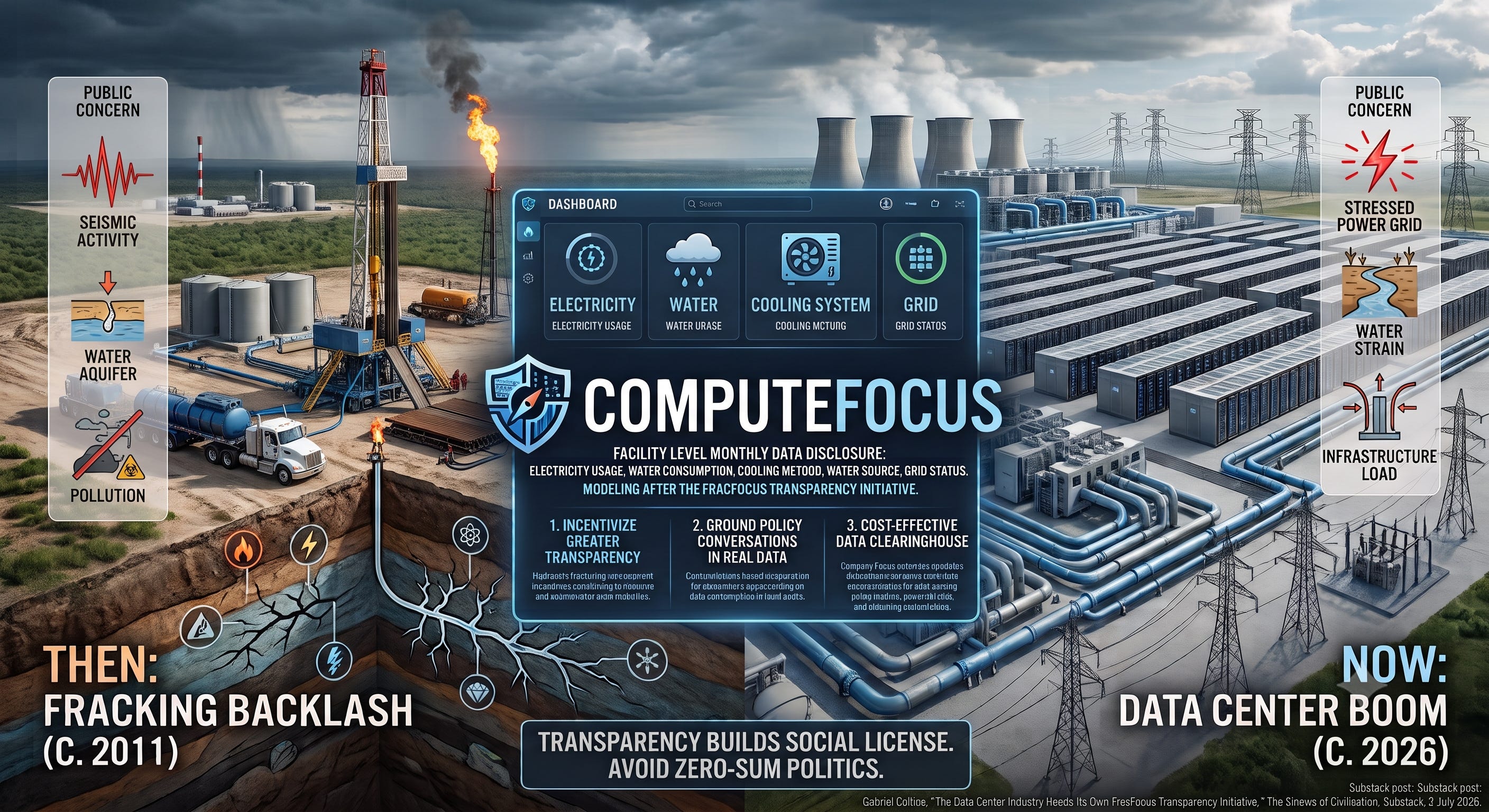
FracFocus achieved at least three core items that data center operators (and the public) would benefit from, if they could be broadly replicated through a ComputeFocus initiative:
1. Reduced competitive incentives for non-transparency. By encouraging more companies to share data, FracFocus relieved concerns that sharing information while one’s competitors did not would somehow put an entity at a disadvantage in the market. ComputeFocus could do the same for data center operators.
2. Grounded policy conversations in real data. FracFocus created a widely accessible and testable dataset to put oil & gas completions activity in context. In the AI infrastructure realm, ComputeFocus could help unlock a more balanced discussion of what we pointed out back in February 2026: “Water is generally local and can be engineered out of operations. Power is non-negotiable for running chips. It is generally regional and comes from expensive generation and transmission assets with complex permitting processes and stressed supply chains.”
The voting public and the representatives they elect both benefit from better understanding these tradeoffs and having the opportunity to independently quantify them through disclosed data. Transparency builds public trust while stronger data foundations equip policy makers to make decisions on the basis of facts, rather than perceptions.
3. Created a cost-effective data clearinghouse. FracFocus appears to cost approximately $1 million per year to operate. That is a fraction of the Data Center Coalition’s annual budget, which suggests industry would not be unduly burdened for funding its side of such as initiative, especially if the Department of Energy also provided financial support. There is also potential for state-level support if state legislatures used FracFocus as a template for structuring ComputeFocus disclosure requirements.
ComputeFocus would not ask for real-time server utilization, customer identities, chip counts, cybersecurity-sensitive facility details, or proprietary workloads. Instead, it would publish facility-level monthly electricity use, water withdrawals/consumption, cooling type, water source, and perhaps non-real-time grid interconnection status.
ComputeFocus would also initially focus on achieving disclosure, while leaving open the later option of beginning to set concrete standards based on data and competitive incentives anchored in performance of best-in-class approaches. Finally, ComputeFocus should also be framed such that transparency is rewarded. In other words, so long as an operator is making good faith efforts to optimize power and water usage based on local conditions, it should be given a grace cushion if disclosure stimulates opposition.
The bottom line is this: the U.S. needs to lead in data center construction and operation in order to lead globally in AI, since datacenters are the digital forges and airports of the AI Revolution. But they are not built and operated in a vacuum. They need social license to operate. Concerns about power and water use are growing fast and have acquired enormous political salience. These can either be addressed broadly and proactively or else be left to the reactive, zero-sum crucible of today’s political process.
As the industry engages with the public and regulators, the ComputeFocus concept offers a framework and analogous set of industrial experiences that can compress FracFocus’s 15-year evolution into a shorter timeframe congruent with the unprecedented speed and scale of the data center boom.
A more transparent U.S. digital infrastructure industry bolstered by a ComputeFocus transparency initiative can drive local legitimacy and with that license, amplify its global competitiveness.
Suggested Citation: Gabriel Collins, “The Data Center Industry Needs Its Own FracFocus-Style Transparency Initiative,” The Sinews of Civilization, Substack, 2 July 2026.